Lesson #04: Contract Testing
Testing Aiken contracts ensures they behave as expected before deployment. This lesson covers:
- Preparing a complex contract for testing
- Building mock transactions in Aiken and running tests with
aiken check
Source code: GitHub
Preparing a Complex Contract
Start by enhancing the withdrawal contract from the previous lesson with two user actions: ContinueCounting and StopCounting.
-
ContinueCounting:
- Verify the transaction is signed by the app owner.
- Ensure the app is not expired (using a POSIX timestamp).
- Carry forward the state thread token to the output.
- Increment the count in the state thread token’s datum by 1.
-
StopCounting:
- Verify the transaction is signed by the app owner.
- Ensure the state thread token is burned (not carried forward to any output).
Contract Code
use aiken/crypto.{VerificationKeyHash}
use cardano/address.{Address, Credential}
use cardano/assets.{PolicyId}
use cardano/certificate.{Certificate}
use cardano/transaction.{Transaction}
use cocktail.{input_inline_datum, inputs_with_policy, key_signed, valid_before}

pub type OracleDatum {
  app_owner: VerificationKeyHash,
  app_expiry: Int,
  spending_validator_address: Address,
  state_thread_token_policy_id: PolicyId,
}

pub type MyRedeemer {
  ContinueCounting
  StopCounting
}

validator complex_withdrawal_contract(oracle_nft: PolicyId) {
  withdraw(redeemer: MyRedeemer, _credential: Credential, tx: Transaction) {
    let Transaction {
      reference_inputs,
      mint,
      extra_signatories,
      validity_range,
      ..
    } = tx

    expect [oracle_ref_input] = inputs_with_policy(reference_inputs, oracle_nft)
    expect OracleDatum {
      app_owner,
      app_expiry,
      ..
    } = input_inline_datum(oracle_ref_input)

    let is_app_owner_signed = key_signed(extra_signatories, app_owner)

    when redeemer is {
      ContinueCounting -> {
        let is_app_not_expired = valid_before(validity_range, app_expiry)
        let is_nothing_minted = mint == assets.zero

        is_app_owner_signed? && is_app_not_expired? && is_nothing_minted?
      }
      StopCounting -> todo
    }
  }

  publish(_redeemer: Data, _credential: Certificate, _tx: Transaction) {
    True
  }

  else(_) {
    fail @"unsupported purpose"
  }
}
This setup defines two user actions with MyRedeemer: ContinueCounting and StopCounting. The partial logic for ContinueCounting applies the validation patterns covered in Lesson 3.
expect
The expect keyword enforces an exact pattern match on a variable. In this example, inputs_with_policy(reference_inputs, oracle_nft) returns List<Input>. Since oracle_nft is unique, the list always contains exactly one item, making expect [oracle_ref_input] a safe destructuring.
? operator
The ? operator in the ContinueCounting branch is a tracing operator. When a validator fails, it reports which condition evaluated to false. For example, if is_app_owner_signed is false, the validator fails with the message is_app_owner_signed?, making it easy to identify the root cause.
Validating Input & Output
We complete the contract by validating inputs and outputs:
use aiken/crypto.{VerificationKeyHash}
use cardano/address.{Address, Credential}
use cardano/assets.{PolicyId, without_lovelace}
use cardano/certificate.{Certificate}
use cardano/transaction.{Transaction}
use cocktail.{
  input_inline_datum, inputs_at_with_policy, inputs_with_policy, key_signed,
  output_inline_datum, outputs_at_with_policy, valid_before,
}

pub type OracleDatum {
  app_owner: VerificationKeyHash,
  app_expiry: Int,
  spending_validator_address: Address,
  state_thread_token_policy_id: PolicyId,
}

pub type SpendingValidatorDatum {
  count: Int,
}

pub type MyRedeemer {
  ContinueCounting
  StopCounting
}

validator complex_withdrawal_contract(oracle_nft: PolicyId) {
  withdraw(redeemer: MyRedeemer, _credential: Credential, tx: Transaction) {
    let Transaction {
      reference_inputs,
      inputs,
      outputs,
      mint,
      extra_signatories,
      validity_range,
      ..
    } = tx

    expect [oracle_ref_input] = inputs_with_policy(reference_inputs, oracle_nft)
    expect OracleDatum {
      app_owner,
      app_expiry,
      spending_validator_address,
      state_thread_token_policy_id,
    } = input_inline_datum(oracle_ref_input)

    expect [state_thread_input] =
      inputs_at_with_policy(
        inputs,
        spending_validator_address,
        state_thread_token_policy_id,
      )

    let is_app_owner_signed = key_signed(extra_signatories, app_owner)

    when redeemer is {
      ContinueCounting -> {
        expect [state_thread_output] =
          outputs_at_with_policy(
            outputs,
            spending_validator_address,
            state_thread_token_policy_id,
          )
        expect input_datum: SpendingValidatorDatum =
          input_inline_datum(state_thread_input)
        expect output_datum: SpendingValidatorDatum =
          output_inline_datum(state_thread_output)

        let is_app_not_expired = valid_before(validity_range, app_expiry)
        let is_count_added = input_datum.count + 1 == output_datum.count
        let is_nothing_minted = mint == assets.zero

        is_app_owner_signed? && is_app_not_expired? && is_count_added && is_nothing_minted?
      }
      StopCounting -> {
        let state_thread_value =
          state_thread_input.output.value |> without_lovelace()
        let is_thread_token_burned = mint == assets.negate(state_thread_value)
        is_app_owner_signed? && is_thread_token_burned?
      }
    }
  }

  publish(_redeemer: Data, _credential: Certificate, _tx: Transaction) {
    True
  }

  else(_) {
    fail @"unsupported purpose"
  }
}
This version introduces several new techniques:
input_inline_datumandoutput_inline_datumextract inline datums from the state thread token’s input and outputinputs_at_with_policyandoutputs_at_with_policyfilter inputs and outputs by address and policy ID- The datum comparison ensures the count increments by exactly 1
For StopCounting, the validator ensures the state thread token is burned by checking the mint field. The without_lovelace function strips the lovelace portion of the value for clean comparison.
Build mock transaction in Aiken
All Aiken contracts are functions that take parameters and return a boolean. This makes testing straightforward: provide mock data and assert the result.
Define test functions with the test keyword, then run aiken check from the project root to execute them.
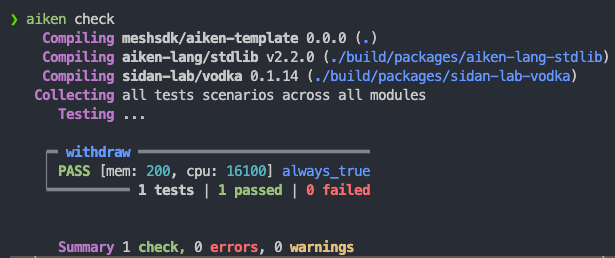
A minimal example:
test always_true() {
  True
}
With aiken check, we will see:
Testing always succeed and always fail cases
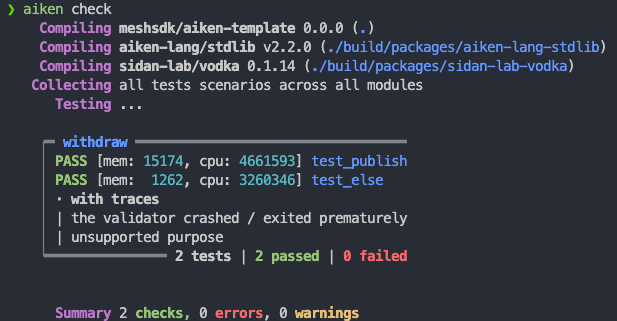
The complex withdrawal contract has a publish function that always returns True. Test it like this:
use mocktail.{complete, mock_utxo_ref, mocktail_tx}

test test_publish() {
  let data = Void
  complex_withdrawal_contract.publish(
    "",
    data,
    RegisterCredential(Script(#""), Never),
    mocktail_tx() |> complete(),
  )
}
This test calls publish with mock parameters. mocktail_tx() creates a mock transaction and complete() finalizes it as an empty Transaction.
All other script purposes fall through to the else branch, which always fails. Test this expected failure:
test test_else() fail {
  complex_withdrawal_contract.else(
    "",
    ScriptContext(
      mocktail_tx() |> complete(),
      Void,
      Spending(mock_utxo_ref(0, 0), None),
    ),
  )
}
The test does not return False; the program breaks with fail. Adding fail after the test name marks the test as expected to fail.
Running aiken check will show:
Testing withdraw function
The withdraw function validates the Transaction structure, so crafting accurate mock data is essential. Building all the required Aiken types manually is tedious, which is where the vodka library helps.
The mocktail module in vodka provides functions for creating mock data. Start with mocktail_tx() to create a base Transaction, then chain modifier functions to fit your test case:
const mock_oracle_nft = mock_policy_id(0)

const mock_oracle_address = mock_script_address(0, None)

const mock_oracle_value =
  assets.from_asset(mock_oracle_nft, "", 1) |> assets.add("", "", 2_000_000)

const mock_app_owner = mock_pub_key_hash(0)

const mock_spending_validator_address = mock_script_address(1, None)

const mock_state_thread_token_policy_id = mock_policy_id(1)

const mock_state_thread_value =
  assets.from_asset(mock_state_thread_token_policy_id, "", 1)
    |> assets.add("", "", 2_000_000)

const mock_oracle_datum =
  OracleDatum {
    app_owner: mock_app_owner,
    app_expiry: 1000,
    spending_validator_address: mock_spending_validator_address,
    state_thread_token_policy_id: mock_state_thread_token_policy_id,
  }

fn mock_datum(count: Int) -> SpendingValidatorDatum {
  SpendingValidatorDatum { count }
}

fn mock_continue_counting_tx() -> Transaction {
  mocktail_tx()
    |> ref_tx_in(
        True,
        mock_tx_hash(0),
        0,
        mock_oracle_value,
        mock_oracle_address,
      )
    |> ref_tx_in_inline_datum(True, mock_oracle_datum)
    |> tx_in(
        True,
        mock_tx_hash(1),
        0,
        mock_state_thread_value,
        mock_spending_validator_address,
      )
    |> tx_in_inline_datum(True, mock_datum(0))
    |> tx_out(True, mock_spending_validator_address, mock_state_thread_value)
    |> tx_out_inline_datum(True, mock_datum(1))
    |> required_signer_hash(True, mock_app_owner)
    |> invalid_hereafter(True, 999)
    |> complete()
}
The mock_... functions from the mocktail module build up the required types. This mock transaction for ContinueCounting includes the oracle NFT reference input with inline datum, state thread token input and output with inline datums, required signer, and validity range.
Test the ContinueCounting action:
test success_continue_counting() {
  complex_withdrawal_contract.withdraw(
    mock_oracle_nft,
    ContinueCounting,
    Credential.Script(#""),
    mock_continue_counting_tx(),
  )
}
Dynamically Testing Failure Cases
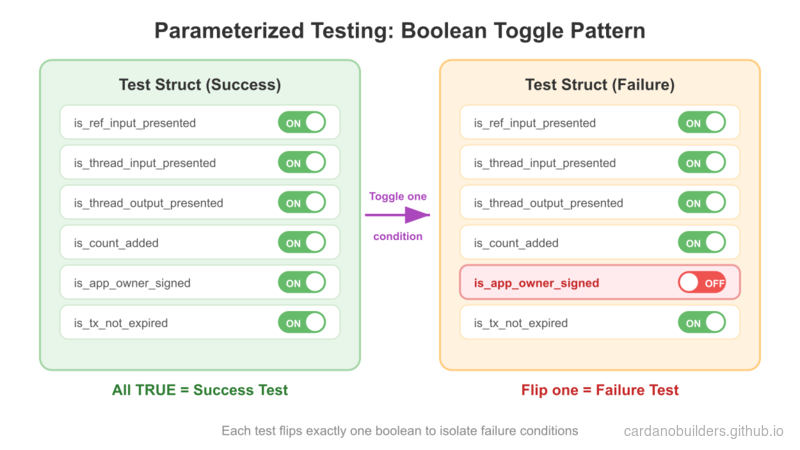
The mocktail builder methods accept a boolean parameter to include or exclude fields. This enables dynamic failure case generation by toggling individual conditions:
type ContinueCountingTest {
  is_ref_input_presented: Bool,
  is_thread_input_presented: Bool,
  is_thread_output_presented: Bool,
  is_count_added: Bool,
  is_app_owner_signed: Bool,
  is_tx_not_expired: Bool,
}

fn mock_continue_counting_tx(test_case: ContinueCountingTest) -> Transaction {
  let ContinueCountingTest {
    is_ref_input_presented,
    is_thread_input_presented,
    is_thread_output_presented,
    is_count_added,
    is_app_owner_signed,
    is_tx_not_expired,
  } = test_case

  let output_datum =
    if is_count_added {
      mock_datum(1)
    } else {
      mock_datum(0)
    }
  mocktail_tx()
    |> ref_tx_in(
        is_ref_input_presented,
        mock_tx_hash(0),
        0,
        mock_oracle_value,
        mock_oracle_address,
      )
    |> ref_tx_in_inline_datum(is_ref_input_presented, mock_oracle_datum)
    |> tx_in(
        is_thread_input_presented,
        mock_tx_hash(1),
        0,
        mock_state_thread_value,
        mock_spending_validator_address,
      )
    |> tx_in_inline_datum(is_thread_input_presented, mock_datum(0))
    |> tx_out(
        is_thread_output_presented,
        mock_spending_validator_address,
        mock_state_thread_value,
      )
    |> tx_out_inline_datum(is_thread_output_presented, output_datum)
    |> required_signer_hash(is_app_owner_signed, mock_app_owner)
    |> invalid_hereafter(is_tx_not_expired, 999)
    |> complete()
}
Update the success test to use the parameterized structure:
test success_continue_counting() {
  let test_case =
    ContinueCountingTest {
      is_ref_input_presented: True,
      is_thread_input_presented: True,
      is_thread_output_presented: True,
      is_count_added: True,
      is_app_owner_signed: True,
      is_tx_not_expired: True,
    }

  complex_withdrawal_contract.withdraw(
    mock_oracle_nft,
    ContinueCounting,
    Credential.Script(#""),
    mock_continue_counting_tx(test_case),
  )
}
Failure cases are now straightforward to create by toggling a single boolean:
test fail_continue_counting_no_ref_input() fail {
  let test_case =
    ContinueCountingTest {
      is_ref_input_presented: False,
      is_thread_input_presented: True,
      is_thread_output_presented: True,
      is_count_added: True,
      is_app_owner_signed: True,
      is_tx_not_expired: True,
    }

  complex_withdrawal_contract.withdraw(
    mock_oracle_nft,
    ContinueCounting,
    Credential.Script(#""),
    mock_continue_counting_tx(test_case),
  )
}

test fail_continue_counting_no_thread_input() fail {
  let test_case =
    ContinueCountingTest {
      is_ref_input_presented: True,
      is_thread_input_presented: False,
      is_thread_output_presented: True,
      is_count_added: True,
      is_app_owner_signed: True,
      is_tx_not_expired: True,
    }

  complex_withdrawal_contract.withdraw(
    mock_oracle_nft,
    ContinueCounting,
    Credential.Script(#""),
    mock_continue_counting_tx(test_case),
  )
}

test fail_continue_counting_no_thread_output() fail {
  let test_case =
    ContinueCountingTest {
      is_ref_input_presented: True,
      is_thread_input_presented: True,
      is_thread_output_presented: False,
      is_count_added: True,
      is_app_owner_signed: True,
      is_tx_not_expired: True,
    }

  complex_withdrawal_contract.withdraw(
    mock_oracle_nft,
    ContinueCounting,
    Credential.Script(#""),
    mock_continue_counting_tx(test_case),
  )
}

test fail_continue_counting_incorrect_count() {
  let test_case =
    ContinueCountingTest {
      is_ref_input_presented: True,
      is_thread_input_presented: True,
      is_thread_output_presented: True,
      is_count_added: False,
      is_app_owner_signed: True,
      is_tx_not_expired: True,
    }

  !complex_withdrawal_contract.withdraw(
    mock_oracle_nft,
    ContinueCounting,
    Credential.Script(#""),
    mock_continue_counting_tx(test_case),
  )
}

test fail_continue_counting_not_signed_by_owner() {
  let test_case =
    ContinueCountingTest {
      is_ref_input_presented: True,
      is_thread_input_presented: True,
      is_thread_output_presented: True,
      is_count_added: True,
      is_app_owner_signed: False,
      is_tx_not_expired: True,
    }

  !complex_withdrawal_contract.withdraw(
    mock_oracle_nft,
    ContinueCounting,
    Credential.Script(#""),
    mock_continue_counting_tx(test_case),
  )
}

test fail_continue_counting_app_expired() {
  let test_case =
    ContinueCountingTest {
      is_ref_input_presented: True,
      is_thread_input_presented: True,
      is_thread_output_presented: True,
      is_count_added: True,
      is_app_owner_signed: True,
      is_tx_not_expired: False,
    }

  !complex_withdrawal_contract.withdraw(
    mock_oracle_nft,
    ContinueCounting,
    Credential.Script(#""),
    mock_continue_counting_tx(test_case),
  )
}
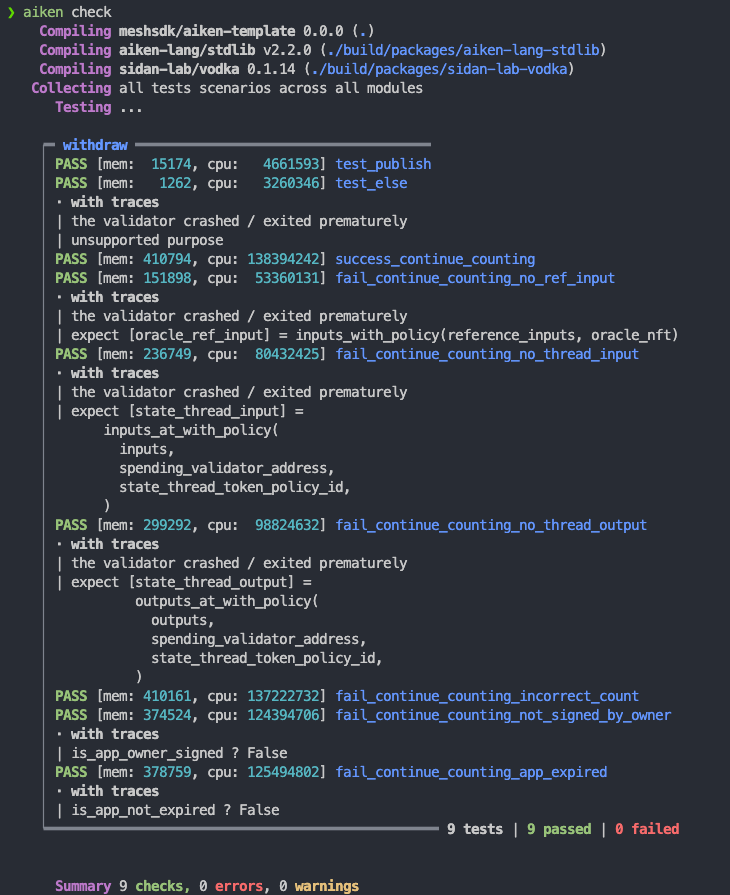
Running aiken check will show:
Exercise
Write tests for the StopCounting action using the same pattern. Follow the ContinueCounting tests as a reference. Suggested answers are available in the code example.
Source Code Walkthrough
This section walks through the project structure and testing patterns used in the source code, connecting them to testing practices you already know from web2 development.
Project Structure
04-contract-testing/
├── validators/
│   └── withdraw.ak       # Complex withdrawal contract with all tests
├── aiken.toml             # Project config (like package.json for Aiken)
├── aiken.lock             # Dependency lock file (like package-lock.json)
└── plutus.json            # Compiled blueprint output (build artifact)
Compared to Lesson 3’s scaffolded project, this is a standalone Aiken project with no mesh/ folder or aiken-workspace/ wrapper. Everything lives at the root.
| Aiken File | Web2 Equivalent | Purpose |
|---|---|---|
aiken.toml | package.json | Declares the project name, version, and dependencies (e.g., vodka for test utilities). |
aiken.lock | package-lock.json / bun.lockb | Pins exact dependency versions for reproducible builds. |
plutus.json | Compiled build output (e.g., dist/) | The compiled Plutus blueprint. Generated by aiken build and consumed by off-chain code to interact with the contract. |
validators/withdraw.ak | src/ + __tests__/ combined | Contains both the contract logic and its test functions in the same file. Aiken does not separate source and test directories. |
Test Architecture: The Mock Transaction Builder Pattern
The core testing pattern in this lesson is building mock transactions with configurable boolean toggles. This is the Aiken equivalent of parameterized tests with fixture factories.
The flow works like this:
- Define a test case struct with boolean fields — one per validation condition in the contract.
- Pass the struct to a builder function that chains
mocktailhelpers. Each boolean controls whether a particular piece of transaction data is included or excluded. - Call the validator with the assembled mock transaction and assert the result.
This pattern maps directly to web2 testing concepts:
| Aiken Testing Concept | Web2 Equivalent | Explanation |
|---|---|---|
aiken check | npm test / bun test | The CLI command that discovers and runs all test functions in the project. |
mocktail_tx() + builder chain | Test fixture factory / request builder | Constructs a fake transaction the same way you would build a mock HTTP request with headers, body, and auth tokens. |
ContinueCountingTest struct | Parameterized test config | A struct of booleans that toggles individual conditions, similar to test.each() in Jest or table-driven tests in Go. |
Boolean toggles (True/False) | Feature flags in test fixtures | Each boolean includes or excludes one piece of the mock transaction, isolating a single failure condition per test. |
test ... fail keyword | expect(...).toThrow() | Marks a test as expected to fail. The test passes only if the validator crashes or returns False. |
expect keyword | assert / runtime type check | Pattern-matches a value and crashes if the shape does not match — like a runtime schema validation. |
? trace operator | Debug logging on assertion failure | Appends the variable name to the error trace when a condition is False, so you immediately see which check failed. |
Why This Pattern Works Well
In web2 testing, you typically write one test per failure mode: missing auth header, expired token, malformed body, and so on. The boolean toggle pattern achieves the same thing for Cardano validators. The success test has all booleans set to True. Each failure test flips exactly one boolean to False, isolating the specific validation rule being tested.
This approach scales cleanly: when you add a new validation condition to the contract, you add one boolean to the struct, set it to True in the success test, and write one new failure test with that boolean set to False.
Source code
The source code for this lesson is available on GitHub.